


Products
Quick Links
About US
FAQ

Copyright © 2026 BGM Co.,Ltd



Views: 0 Author: Site Editor Publish Time: 2025-09-17 Origin: Site


You play backgammon by following the rules for backgammon board game, which are easy to understand. You move your checkers after you roll the dice, aiming to take all your pieces off the board first, while your opponent tries to do the same. Many new players think it is simple to start. You can enjoy the game with friends or family.
Common beginner challenges include:
Learning the basic rules for backgammon board game
Making legal moves
Understanding strategy
You do not need any skill to start. Online tools like SimplyBG and USBGF Learning Tools help you learn fast.
Understand the basic setup of the backgammon board. Place your checkers correctly to start the game on the right foot.
Learn the objective: Move all your checkers into your home board and bear them off before your opponent does.
Use the doubling cube wisely to increase the stakes. Offer a double when you feel confident about your position.
Always check for legal moves. You can only land on open points and hitting an opponent's blot can give you an advantage.
Practice makes perfect. Regular play helps you improve your strategy and enjoy the game more.
You set up the backgammon board game on a board with 24 narrow triangles called points. These points alternate in color and form four groups of six, known as quadrants. Each quadrant sits in a corner of the board. The board also has a bar running down the center, dividing the two sides. You and your opponent sit facing each other, each with your own home board and outer board.
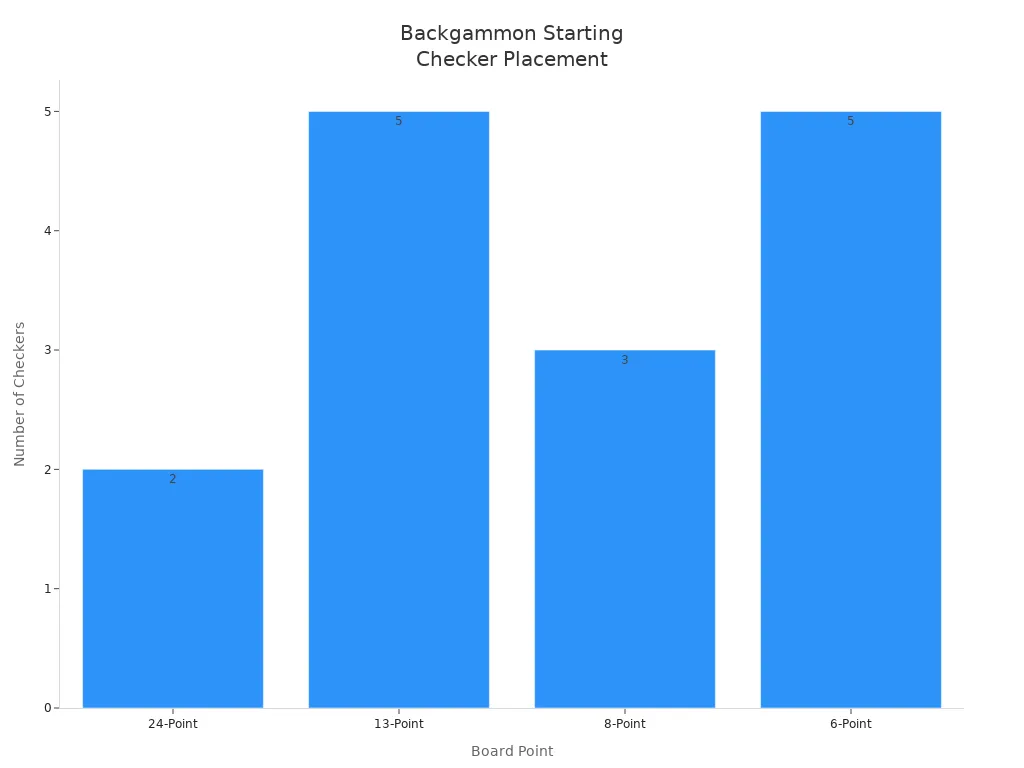
Each player starts with fifteen checkers in a contrasting color. You place your checkers on specific points to begin the game. The standard arrangement is:
Point | Number of Checkers |
|---|---|
24-Point | 2 |
13-Point | 5 |
8-Point | 3 |
6-Point | 5 |
You put two checkers on the 24-point, five on the 13-point, three on the 8-point, and five on the 6-point. This setup is the same for both players, but the direction of movement is opposite. The goal is to move all your checkers around the board and into your home quadrant.
Tip: Always double-check your checker placement before you start. A correct setup helps you learn the backgammon board game faster.
To decide who goes first, each player rolls one die. The player with the higher number starts the game. You use the numbers from both dice for the first move. If you both roll the same number, you roll again until someone wins. This simple rule keeps the start of every backgammon game fair.
You play backgammon with a clear goal in mind. Your main objective is to move all your checkers into your home board and then bear them off before your opponent does. The official rules highlight this aim. You can see the goal in the table below:
Objective of Backgammon |
|---|
Move all your checkers into your home board and then bear them off before your opponent does. |
You start by moving your checkers around the board in a set direction. Each roll of the dice gives you a chance to advance your pieces. You must plan your moves so you reach your home board quickly. When all your checkers sit in your home quadrant, you begin the process called "bearing off." This means you remove your checkers from the board, one by one. The first player to bear off all fifteen checkers wins the game.
Tip: Focus on moving your checkers safely. Avoid leaving single checkers alone, as your opponent can hit them and send them to the bar.
You win a game of backgammon by bearing off all your checkers before your opponent does. The game ends as soon as one player removes their last checker from the board. You can win in three ways:
Single Game Win: You bear off all your checkers before your opponent bears off any.
Gammon: You bear off all your checkers while your opponent still has checkers on the board.
Backgammon: You bear off all your checkers while your opponent still has checkers on the board and in your home board or on the bar.
Each type of win gives you different points. You score more for a gammon or backgammon win. You should always try to bear off your checkers as quickly as possible. Watch your opponent’s moves and adjust your strategy to stay ahead.
You start each turn in backgammon by rolling two dice. Most players use a dice cup to shake and toss both dice at the same time. You must make sure each die lands flat on the playing field or on top of the checkers. If a die lands on its edge, corner, or is supported by the side of the board, you need to roll again. Both dice must be visible and resting on the board or checkers. If either die falls off the board or is not clearly on the surface, the roll does not count, and you must roll again.
Tip: Always check your dice after rolling. A valid roll keeps the game fair and avoids confusion.
A die must come to rest on the playing field or on checkers to be considered valid.
If a die is supported by a vertical surface, balanced on its edge or corner, or descends below the top surface of all checkers on which it rests, a re-roll is required.
If either die is not located on the playing surface or on the checkers, the entire roll is invalid.
After you roll the dice, you move your checkers according to the numbers shown. Each die represents a separate move. For example, if you roll a 3 and a 5, you can move one checker three spaces and another five spaces, or you can move one checker a total of eight spaces by splitting the moves. You must use both dice if possible. If you can only use one die, you must play the higher number.
Many beginners make mistakes when moving checkers. You might waste checkers by burying them deep in your home board, making them inactive. Stacking too many checkers on one point creates a candlestick, which limits your options and makes your position inflexible. Good movement is a key part of how to play backgammon and helps you develop a strong strategy for beginners.
Avoid burying checkers in your home board.
Do not stack too many checkers on a single point.
You must follow the official rules for legal moves in backgammon. You can only move your checkers to open points. An open point is a triangle that is not occupied by two or more of your opponent’s checkers. If a point has only one opponent checker, you can land there and hit it. If you cannot make a legal move with either die, you lose your turn.
Aspect | Description |
|---|---|
Movement | You roll two dice and move checkers according to the numbers. Checkers must land on open points (not occupied by two or more opponent checkers). |
Hitting | If a point has one opponent checker, you can hit it and send it to the bar. |
Entering | A hit checker goes to the bar and must re-enter the opponent’s home board before other moves, based on the dice roll. |
Bearing Off | If no legal move is possible, you lose your turn. |
Note: Always check if your move is legal before you pick up your checkers. This habit helps you avoid mistakes and keeps the game moving smoothly.
When you land on a point with only one opponent checker, you hit it and send it to the bar. The bar sits in the middle of the board and holds checkers that have been hit. Hitting an opponent’s checker can trap them on the bar and slow their progress. This move gives you a positional advantage and helps you advance your own checkers. You must watch out for blots, which are single checkers left alone. If your opponent hits your blot, you go to the bar and lose time in the race.
Hitting can trap your opponent and disrupt their progress.
Successfully hitting gives you a positional advantage.
Leaving blots exposes you to being hit and sent to the bar.
If your opponent has a strong home board, getting hit can be especially harmful.
If your checker is on the bar, you must re-enter it into your opponent’s home board before you can make any other moves. You do this by rolling the dice and placing your checker on an open point that matches the number rolled. If all possible points are blocked, you lose your turn and must wait until you roll a number that lets you enter.
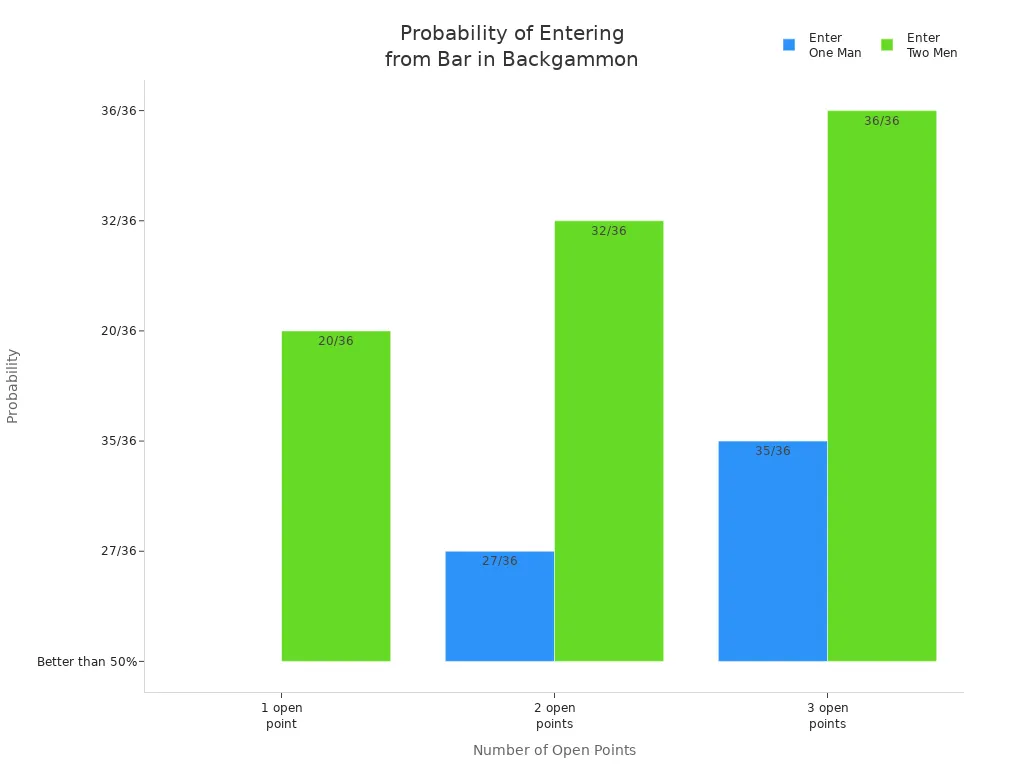
The chance of re-entering depends on how many open points your opponent leaves. With one open point, you have better than a 50% chance of entering one checker. With two open points, your odds improve. If you have two checkers on the bar, you need at least five open points to have a better than 50% chance of entering both.
No. of Open Points | Probability of Entering One Man | Probability of Entering Two Men |
|---|---|---|
1 | Better than 50% | 20/36 |
2 | 27/36 | 32/36 |
3 | 35/36 | 36/36 |
Tip: When learning how to play backgammon, try to keep your opponent’s home board open. This makes it easier to re-enter if you get hit.
Once you move all your checkers into your home board, you can start bearing off. You bear off by rolling the dice and removing checkers from the points that match the numbers rolled. If you roll a number higher than your highest occupied point, you can bear off a checker from the highest point. You must have all 15 checkers in your home board before you start bearing off.
Rule/Requirement | Description |
|---|---|
All checkers must be in home board | You cannot start bearing off until all 15 checkers are in your home board. |
Rolling a number | You must move the furthest back checker corresponding to the number rolled. |
Legal checker to bear off | You can choose any legal checker to bear off, not necessarily the highest number rolled. |
Victory types | Winning can be standard, gammon, or backgammon based on the opponent's remaining checkers. |
Note: Bearing off is the final step in how to play backgammon. Focus on removing your checkers quickly and safely. This step often decides the winner, so use a smart strategy for beginners to finish strong.
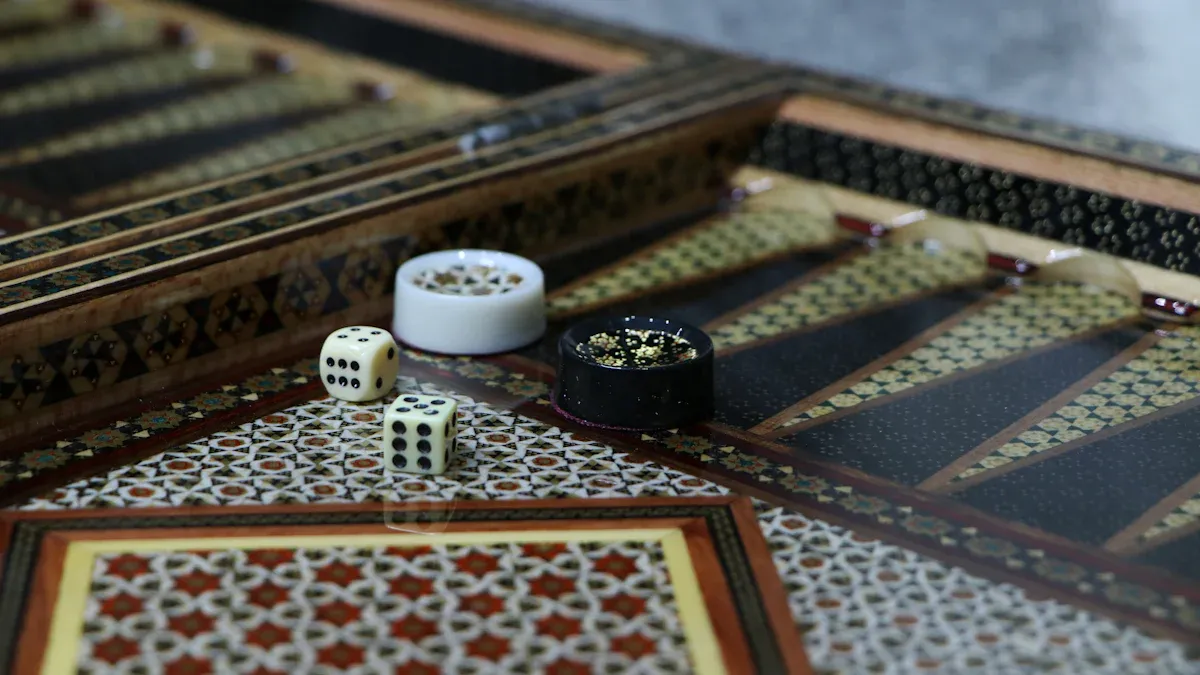
You see a special cube with the numbers 2, 4, 8, 16, 32, and 64 on the backgammon board. This is the doubling cube. The rules for backgammon board game include this cube to make the game more exciting. You use the doubling cube to raise the stakes during play. If you feel confident about your position, you can offer a double to your opponent. If your opponent accepts, the value of the game doubles. If your opponent declines, you win the current points and the game ends.
Grosvenor Nicholas introduced the doubling cube in 1931. He helped modernize backgammon in the United States. His writings and influence convinced equipment makers to add the cube to the standard set. Some people mention W. Whitewright Watson, but most agree Nicholas made the doubling cube a regular part of the rules for backgammon board game.
Tip: You can only offer a double at the start of your turn, before you roll the dice.
Cube Side | Game Value |
|---|---|
2 | Double |
4 | Quadruple |
8 | 8x |
16 | 16x |
32 | 32x |
64 | 64x |
You need to know when to use the doubling cube. The rules for backgammon board game give you several chances to double. You should look for these common situations:
You have a strong lead and want to increase your points.
Your opponent risks getting gammoned or backgammoned, so doubling can boost your score.
You want to add pressure and make your opponent think harder.
You must follow the backgammon rules and only double before your roll. If your opponent accepts, the cube moves to their side. Only the player who accepted the last double can offer the next one. You can use the doubling cube to change the pace and strategy of the game. The rules for backgammon board game make the cube a key part of competitive play.
Note: Doubling adds excitement and strategy. You can win more points, but you also risk losing more.
You score points in backgammon by following the basic backgammon rules. Each time you win a game, you earn points based on how you finish. If you bear off all your checkers before your opponent, you get 1 point. This is the most common way to win. If you use the doubling cube, the value of the game increases. The cube shows numbers like 2, 4, 8, 16, 32, and 64. When you accept a double, you play for more points. The cube also tells you who can offer the next double.
In tournaments, players compete in matches. You play a series of games, and each win adds to your score. The first player to reach the set number of points wins the match. For example:
You and your opponent play a match to 5 points.
Each game you win adds 1 point to your total.
The first to reach 5 points wins the match.
Tip: Always keep track of the score and the value of the doubling cube. This helps you plan your moves and decide when to double.
You can earn extra points by winning with a gammon or a backgammon. The basic backgammon rules explain these special wins:
If you bear off all your checkers and your opponent has not borne off any, you win a gammon. This is worth 2 points.
If your opponent still has checkers on the bar or in your home board when you finish, you win a backgammon. This is worth 3 points.
Here is a quick guide:
Type of Win | Points Earned |
|---|---|
Standard Win | 1 |
Gammon | 2 |
Backgammon | 3 |
Gammon wins happen about 15% of the time in competitive play. If your opponent has two checkers on the bar and you close your home board, your chance of winning a gammon can rise to 40% or more. In some positions, you might even have a 53% chance.
You should always remember the basic backgammon rules for scoring. Try to finish with a gammon or backgammon when you have the chance. This can help you win matches faster and improve your skills.
You can find many ways to play backgammon around the world. Each variation adds a unique twist to the game. Some rule changes come from different countries or cultures. Others make the game faster or more challenging. Here are some of the most popular backgammon rule variations you might encounter:
Tavla / Takhteh Nard – This version comes from Turkey and Iran. You do not use the doubling cube, and you cannot hit blots in some cases.
Acey-Deucey – Sailors often play this version. You get extra moves when you roll a 1 and a 2.
Narde – In Russia, players enjoy this style. You cannot hit blots, so the game feels more strategic.
Plakoto – In Greece, you trap your opponent’s checker by landing on it, instead of sending it to the bar.
Gul bara – This Turkish game lets you move checkers in both directions.
Acey-Deucey on the Bar – This twist changes how you re-enter checkers from the bar.
Fevga – Greek players use only one checker per point, which changes your strategy.
Moultezim – This version is popular in the Middle East and uses a different starting setup.
Gioul – You can move checkers in both directions, making the game unpredictable.
Hypergammon – You start with only three checkers, so games finish quickly.
Nackgammon – You use a special starting position to create new challenges.
LongGammon – You move all checkers from the same starting point, which tests your patience.
Try learning a new variation to keep your backgammon games fresh and exciting. Each style teaches you something new about strategy.
You might also play backgammon with house rules. These are special rules that you and your friends or family agree on before the game starts. House rules can make the game more fun or fit your group’s style. For example, you might decide to skip the doubling cube, allow re-rolls for certain dice, or set a time limit for each turn.
Some groups let you re-enter checkers anywhere, not just in the home board.
Others change the number of checkers or points needed to win.
You can even invent your own rules to create a unique experience.
House rules help everyone enjoy the game. Always agree on the rules before you begin. This keeps the game fair and fun for all players.
You can master backgammon faster when you keep the main rules in mind. Use this checklist to guide your play and avoid confusion during the game.
Set up the board correctly: Place your checkers on the right points before you start. Make sure each player has fifteen checkers in the standard positions.
Know your opening moves: There are 15 possible combinations for your first dice roll. Learn the best moves for each to get a strong start.
Focus on three main goals in the opening:
Secure a point in your home board.
Unstack heavy points to spread your checkers.
Free your back checkers so they can move forward.
Roll both dice at the start of each turn: Use a dice cup for fairness.
Move checkers according to the dice: Each die gives you a separate move. You must use both numbers if possible.
Land only on open points: You cannot move to a point with two or more of your opponent’s checkers.
Hit blots when you can: If your opponent leaves a single checker, you can land there and send it to the bar.
Re-enter from the bar before other moves: If you have a checker on the bar, you must bring it back into play first.
Bear off only when all your checkers are in your home board: Remove checkers by rolling the right numbers.
Use the doubling cube wisely: Offer a double only at the start of your turn.
Tip: Review this checklist before each game. It helps you remember the basics and play with confidence.
You can improve your game by watching out for these frequent errors:
Mistake Description | Explanation |
|---|---|
Panic during gameplay | You might make poor choices if you react too quickly to high rolls. |
Moving checkers too far early | Advancing too fast can leave blots and make your checkers easy targets. |
Being overly timid | Playing too safe can slow your progress. Take smart risks when needed. |
Remember: Stay calm, plan your moves, and balance risk with safety. This approach helps you enjoy backgammon and win more games.
You have learned the easy rules for backgammon. Play this two-player game with your friends or family. Practicing will help you improve and make each game simpler. Backgammon helps your memory and makes you better at solving problems. It also helps your brain by making you plan your moves. You learn to think carefully and pick up new tips every time you play. Have fun and enjoy the challenge when you play backgammon at game night!
You play backgammon with two players. Each person controls fifteen checkers and tries to move them around the board faster than the opponent. You cannot play with more than two people at the same time.
You get to move double the amount shown on the dice. For example, if you roll two fours, you move four checkers four spaces each. Rolling doubles gives you a big advantage during your turn.
You must play if you have a legal move. If you cannot move any checker because all possible moves are blocked, you lose your turn. You wait until your next roll to play again.
A blot is a single checker sitting alone on a point. If your opponent lands on your blot, you go to the bar. You should avoid leaving blots to keep your checkers safe.